Anti-Globalization Movement Heads to NY

People's Summit - Anti-Globalization Movement Heads to NY
Washington Peace Letter
Washington Peace Center
1801 Columbia Road NW
Suite 104
Washington, DC 20009
Ph. (202) 234-2000
Fax (202) 234-7064
Email: wpc@igc.org
Web site: www.washingtonpeacecenter.org

The Washington Peace Letter is published monthly for the social justice community of the Washington, D.C. metropolitan area. Its purpose is to support local, national and international struggles against oppression. It seeks to present a radical analysis of current events, covering information not readily available in the corporate media.

The Peace Letter welcomes submissions of calendar announcements, articles, letters to the Editor, and artwork from the progressive community. Articles may be from 300-1200 words, but may be edited for space considerations. Preference is given to materials that cover actions or organizing campaigns in the D.C. metropolitan area.

We reserve the right to select or reject any submission.

Except as noted, Peace Letter items are copyright free and may be reproduced. Please give credit and send us a copy if you do use something.

The Washington Peace Letter is a project of the Peace Talks Working Group of the Washington Peace Center. If you are interested in joining us, call!

Anti-Globalization Movement Heads to NY
by Ana Nogueira

September 2000

It's a hectic time for anti-globalization activists. So many issues, too many international institutions. So many meetings to protest at, such little time to organize. Not to mention that we all have to go to work in the morning.

Yet, the anti-globalization movement keeps marching, from continent to continent, expanding in depth and breadth, scope and vision.

September alone is host to at least four more exhibitions of this incredible show of people power, beginning with September 8th in New York City. S8, as it is affectionately known, is the last day of the United Nations Millennium Summit, the largest gathering of heads of state in history. As the "leaders" of the world convene to consider the ratification of over 500 beautifully worded treaties at this historic and unprecedented Millennium Summit, thousands of people will be assembling in Central Park, NYC, to hear many of the same anti-globalizationists that spoke to the issues at the Battle of Seattle and at A16.

S8, or "The People's Summit," is convening on the streets of the capital of the world in objection to basically everything under the umbrella of globalization. Since the United Nations represents every nation in the world, protests outside the Summit represent almost every problem in the world.

Contingents will be there representing "a dizzying array of issues," (to quote a popular mainstream media phrase), such as women's rights, human rights abuses, sanctions as a form of dictatorship, dictatorship in general, militarization, poverty, racism, ecological devastation, biological engineering, exploitative labor, cultural dissolution, governmental corruption, imperialism, the erosion of democracy, and the corporate agenda of the IMF, World Bank, and World Trade Organization (WTO).

In all the protests that have happened since Seattle, the common thread is precisely the realization that these issues are related to each other, and it is this realization that has created the worldwide alliance of activists and NGO's, anarchists, and reformers, determined to change the world.

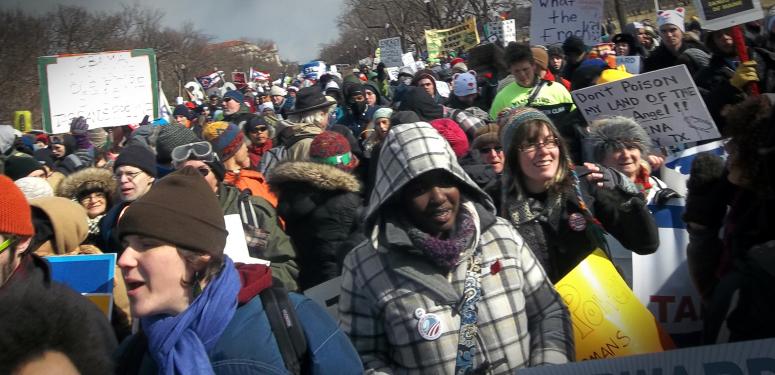
Following the Central Park rally, there will be a march down Fifth Ave, with direct actions happening simultaneously at various locations around the city, leading to the culmination of the day's events at the Dag Hammersjkold Plaza just a few blocks from the heavily guarded UN buildings. Whatever the weather, S8 promises to be another beautiful day of demonstrating that the people have had enough.

However, S8 differs from all the other days of global action in one crucial aspect: It has served to highlight just how fragile this alliance can be when it comes to talking about alternatives and the means of achieving them.

Being that the UN is largely comprised of NGO's and representatives of the global south, and its founding mission is to promote humanitarianism and international solidarity, a division has developed over what the demands on the UN should look like and whether the UN can be at all salvaged from it's current state of inefficacy in the first place.

It is easy to take one hard look at the IMF, the World Trade Organization, and even the World Bank and simply say, abolish them. Anarchists and most progressives believe that the world would simply be better off without these undemocratic, hierarchical, supranational entities that have done nothing but devastate local environments, economies, and communities.

But can the same be easily said of the United Nations? Known for its Declaration of Human Rights, its long list of initiatives declaring the need for more peace and harmony amongst the people of the world, not to mention the fact that many cherish it as the only internationally recognized body that represents the interests of "third world" populations, should we be arguing for its complete dissolution?

There is no disagreement over the fact that the UN is not living up to its mandate. All the organizing bodies and endorsing organizations agree that the UN is merely just another forum for "impotent rhetoric," as the call to action says, and is incorporating many of the same operating practices of all the other heinous international institutions. Everyone agrees that the UN is extremely undemocratic and hierarchical, especially when one considers the powers of the Security Council and more specifically the veto power of the United States, making the UN's claim to be representatives of third world concerns laughable.

All agree, too, that the inclusion of military dictators in the Assembly is a direct violation of the principles of the UN Charter, and most recently, the Global Compact between the UN and sweatshop-operating multinational corporations is outrageous and should be grounds for the removal of U.N. Secretary General Kofi Annan.

So where's the dilemma?

The problem becomes clear when you consider the rationale behind the blocks within the NYC branch of the Direct Action Network against endorsing the action. Blockers to consensus argue that anything short of calling for the abolishment of the United Nations implicitly assumes that nations are legitimate entities in and of themselves, and that their presidents, prime ministers and ambassadors are democratically elected, accountable, and derive their decisions directly from the will of the people. Others believe that despite its supposedly altruistic mission, the powerlessness of the UN is incurable due to its bureaucratic structure and submissiveness to US power interests, and hence, reform is an inadequate solution.

It's the old radical vs. reformist debate. But pitted against the time crunch of organizing a protest for September 8th, targeted at the largest gathering of heads of state ever to assemble, at a turning point in the UN's history as we watch it climb into bed with multinational organizations, this classic argument suddenly brings into sharp and urgent focus the question of 'to what level of attack do we take this movement and how quickly do we want to get there'?

Many feel that while maintaining a utopian vision at the forefront is crucial, utilizing existing forums that are not inherently beholden to the dominating economic imperialist system and which do not base their existence on capitalist needs, greeds or philosophies, could be a good foundation for a future whose objective is "democratization, not corporatization." At the very least, protests at the Summit could empower those who are at the table but are marginalized, just as protestors outside the WTO meetings in Seattle chanting "Africa – Don't Vote" empowered delegates with more leverage and in the end, shut the meeting down.

The organizers of S8, taking all of these perspectives into account, have tried to draft the call in such a way as to allow for all points of view to fall under its umbrella. With anarchists in mind, it has left out any demands on the UN to ratify specific treaties, and with reformists in mind, avoided language that calls for the explicit destruction of the UN. It's has boiled the issues down to what all can agree are immediately unacceptable global problems and focused the solution on the "democratization, not corporatization" of the world in general, leaving specific proposals to be outlined during the day in a long series of speeches by endorsing organizations and keynote speakers. This, after all, is what democracy looks like.

And so, it does seem like both perspectives will be freely aired at the People's Summit. But the strong alliance that has inspired activists from all over the world, coming from a wide range of ideological perspectives, has more work to do to solidify it's common ground without recreating factionalism.

The International Forum on Globalization will be holding a teach-in on Tuesday, September 5th in NYC to address this very issue. For more information and to register, please visit www.ifg.org.

If you would like to be part of the organizing for S8, send a blank email to S8-Mob-subscribe@topica.com. If your organization would like to endorse and/or financially sponsor the demonstrations, please email S8-mob@onebox.com

To read the Call to Action, visit the web site at www.peoplessummit.org