Corporate Health Care: Stay Healthy Or Else!
By Scott McLarty
June 1998
Volume 35 Number 5
The media rarely mentions it. Politicians avoid it. The District of Columbia is in the midst of a major health crisis, which we almost never hear about until the newspapers report more bad news. One example saw the light of day on December 4, 1997, when The Washington Post reported findings from epidemiologists at the Harvard School of Public Health.
The findings showed that men in D.C., i.e., mainly African American men, suffer a severely diminished life expectancy. D.C. men have an average life span of about 62, 14 years less than the average for Fairfax County.
Meanwhile, the rest of us worry about the quality of our health care; the insurance restrictions on which physicians we are allowed to see; finding ourselves without benefits if we change or lose jobs; or seeing our benefits reduced or rates raised. The New York Times reported recently that “[f]or the first time since 1992, many employers are facing double-digit increases in the cost of their health insurance next year, the highest inflation rate since the majority of employees moved into managed care... [M]any Americans covered by employee-sponsored health plans may see a larger share of their paychecks go to health insurance or see coverage cut back” (“Health Insurers Seek Big Increases In Their Premiums,” April 24, 1998).
Those without coverage rush to the hospital emergency room for primary care, and for secondary or tertiary care, often do without. The rest of us pick up these costs in our taxes and in higher fees, for both the emergency room primary care and for the social disruption caused by untreated illness.
One reason our Mayor, City Council members, department heads, and business leaders avoid the subject is that an effective remedy would require the restructuring of the entire system. We’d have to socialize coverage, a notion that’s anathema at a time when Congressmembers want to privatize Social Security, Medicare, and Medicaid, and abandon the social safety net to the whims of the free market.
The triumph of corporate health care is a distinctly American public relations coup. The U.S. is the only advanced industrial democracy that refuses to cover all of its citizens. (The UN Universal Declaration of Human Rights recognizes the right to health care. The U.S. ignores it.) We’ve got the best medical technology—and the worst access.
Guaranteed Health Care in Washington, D.C.?
Activists in groups like the D.C. Green Party and ACT UP Washington have held informal discussions about guaranteed District-wide quality health care. Successful implementation here would prove that universal care could work anywhere. But we’d face not only D.C.’s distressed financial condition and low income average, but a Financial Control Board (acting at the behest of a hostile and pro-corporate Congress) likely to nullify any such attempt. Further complications include the “national” health coverage many D.C. residents enjoy as federal employees—how do we integrate them into a D.C. system?—and suspicions (often justified) about the ineptitude of D.C. agencies.
Nevertheless, we’d benefit from a study of the financial feasibility of a D.C. plan. The General Accounting Office declared single-payer the most financially solvent of all national reform plans. If D.C. can fashion a plan that provides every resident with quality care, and simply break even, we’d lead the nation—not to mention save lives.
How It Works
Single-payer universal health care works like this: You’re injured or you fall sick, you go to the doctor, the doctor treats you and sends the bill to a state agency, which sends him or her the payment. Taxpayers would pay into the agency through a progressive surtax, which would be less expensive than insurance or HMO payments for all except the wealthy. Everyone is covered, regardless of employment, housing, age, or medical condition. The single-payer bill introduced by Senator Paul Wellstone of Minnesota, based on Canada’s successful system, filled about 35 pages; Bill Clinton’s “managed care” gift to the major insurance firms was more than a thousand pages of regulation and explanation.
At the beginning of the 1970s national spending on health care was about 7% for both Canada and the U.S. Now, Canada spends 9-10% while the U.S. pays about 15%. Single-payer eliminates the extra expense of a middle-man, i.e., profit-making private insurance HMO corporations. The government agency that processed medical bills wouldn’t need to skim off an extra layer of money to satisfy investors.
Yes, such an agency would be a bureaucracy, subject to bureaucratic failings—but the private profit-driven bureaucracies that dictate our health coverage now remain vastly more remote from accountability to the public. Americans often accuse Canada of rationing health care, but so does the U.S., through the exclusionary practices of insurance firms and HMOs, which operate according to the rules of “free market” corporate capitalism and the scarcity it imposes. These same anti-democratic corporations dominate our media, our politicians, and every step of the legislative process. You and I remain frozen out of the system... until we organize.
Organizing for Universal Health Care
Single-payer universal health care is hardly a radical concept. “Health care is an essential safeguard of human life and dignity,” wrote Cardinal Bernardin, in an October 1995 pastoral letter, “and there is an obligation for society to ensure that every person be able to realize this right.”
The American College of Surgeons, which speaks for the nation’s highest paid physicians, endorsed single-payer in 1993. The D.C. Medical Society endorsed it in 1996. Physicians for a National Health Plan (PNHP) has organized doctors in several states, including Massachusetts, Rhode Island, and New Mexico, to press for guaranteed coverage.
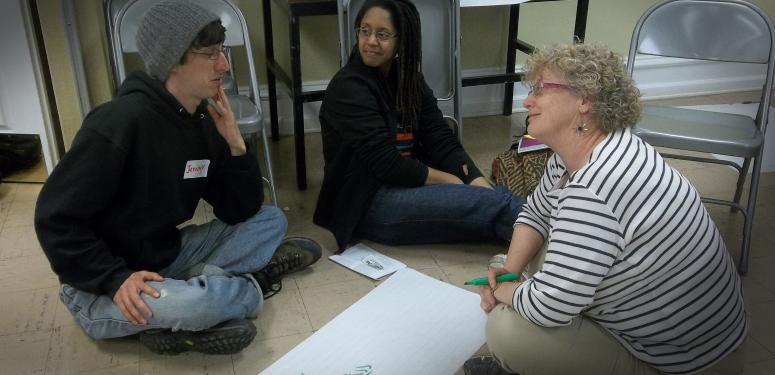
On April 1 and 2, Americans for Democratic Action (ADA) held a national “leadership conference” in Crystal City to consider such problems, and to discuss strategies for bringing universal health care to the U.S. Titled “Health Care Justice: Building a New Movement for Universal Health Care,” it was attended by physicians, nurses, union organizers, activists from groups like Universal Health Care Action Network (UHCAN) and PNHP, and the concerned public.
The risks of a market-based health care system include more people uninsured, more people vulnerable to loss of coverage, increased risk for sick people. Private insurers don’t want to compete for coverage of people who need care, or they’d get too many sick customers and go out of business. There’s no such thing as “quality care” when some people are not covered, or coverage is threatened.
Under the current economy, i.e., since 1995, an average income tax increase of 39% would finance national health care. That comes to an average of $3,475 for an average family, much less than the current $5,200 average annual health insurance premium. But there are ways to reduce this figure, especially by phasing in the system or increasing the share paid by employers. The U.S. General Accounting Office says there’d be no cost increase under universal coverage. Fears of increased use of services proved unfounded in Canada.
At the conference, Dr. Jerry Lieberman discussed problems of quality and delivery, including the fact that care in rural areas is always worse than cities, where those without coverage can visit a nearby emergency room. Inner city poor folks thus get some primary care, but lack secondary and tertiary care, especially for chronic and long-term illness. Lieberman believes we must gain universal care in the U.S. through a federal plan, since the economies of poor states like Mississippi are unlike those of California, New York, etc.
Our task is comparable to the push for Social Security and Medicare, which faced stiff opposition in the 30s and 60s, respectively. Dr. Quentin Young, president of the American Public Health Association and past president of PNHP and Physicians for Human Rights, discussed the Republican “anti-government” ideological victory and the corporate takeover of the medical profession. Corporations will resist socialized coverage. They consider our health care their private property. We can anticipate propaganda about how universal health care would force working middle class folks to pay for those undeserving poor folks, blacks, immigrants, etc. But the rest of us already pay for the uncovered, who use emergency rooms for primary care and otherwise get many services without paying. We pay through higher bills, premiums, and taxes. (Medicaid only covers 40% of the poor, because of arbitrary eligibility requirements.)
There are several challenges for supporters of universal health care: (1) how to get people to trust in a government agency, when “big government” is now considered the enemy; (2) how to unite all health activists with particular concerns (breast cancer, AIDS, postnatal care, heart disease, etc.); (2) how to persuade a Congress hostile to the idea of universal health care—should we instead seek universal care within states?
Ken Frisoff of UHCAN (Universal Healthcare Action Network) reminded us that Canada doesn’t have one system, but 12, all bound together by the Canadian Health Act. Perhaps devolution to the state level is the right approach for the U.S. Many states are centralizing school funding, to reduce inequities among towns, counties, etc. The federal government can be the leader in terms of general principles, not micro management of state-based health care coverage.
States now have a legal basis on which to insure everyone, thanks to the New York Blue Cross/Blue Shield versus Travelers Supreme Court decision of 1995, which said that states cannot govern quality of care, but do have the right to impose taxes to cover the uninsured. On the other hand, Ted Steege, chair of the Inter-religious Committee for Health Care here in D.C., helped put together the Wisconsin Universal Health Plan, a state bill which, despite support from 90 organizations in coalition, lots of Democratic sponsors, and popular support, was stopped by the agenda controllers in the Wisconsin legislature. It’s not enough to draw up and introduce a good plan with popular support.
Developing Strategy
Despite our private system, 60% of all health care expenditures are public money. Shelley Moskowitz of D.C. Neighbor-to-Neighbor discussed our need to change the political climate by revealing the insurance companies for the profit-motivated corporations that they are, broadening our base through grassroots democratic involvement of working families, minorities, the poor, old folks, etc., and gaining some victories through steps like passage of a “Patient Protection Act.” We should also adopt a broad agenda that include goals like a living wage and universal child care.
Cathy Hurwit of AFSCME expanded the list of strategies, suggesting that we “go where people are, not where we are.” We need to work with people fighting private school vouchers and other privatization of resources and services, physicians who want to escape overregulation by insurance and HMO bureaucracies, and even businesses that resent having to provide coverage.
Other strategies for a public campaign include: identifying common targets and enemies—exposing CEOs!; demonstrating how people themselves will benefit, through greater affordability, full availability of long term care, etc., and addressing the special needs of older people; adapting to new developments in the health care field, such as organizing doctors who are now employed by HMOs; holding neighborhood teach-ins.
Let’s promote universal health care every chance we can. Let’s listen to the stories of those who’ve had care denied, because of HMO or insurance restrictions or lack of coverage. Let’s remind people that, although no system is perfect, universal care is a moral obligation. It’s worth the effort.
The Universal Health Care Action Network, which plans to hold a conference in Arlington in early October, can be reached at UHCAN, 2800 Euclid Avenue, Suite 520, Cleveland, OH 44115-2418; Tel: 800/634-4442; Fax: 216/241-8423; Email: uhcan@uhcan.org; Web Site: www.uhcan.org
Scott McLarty is a member of the Green Party of the District of Columbia. He has campaigned for single-payer national coverage since 1992, especially for Senator Paul Wellstone’s bill, and has published in In These Times, Z Magazine, The Progressive Review, and the Washington Peace Letter.