Thousands Rally for Peace and Justice!

Peace Letter 39-3
 

Thousands Rally for Peace and Justice!
Organizing for Peace
By Betty Hurst

February 2002
Volume 39 Number 3


A broad peace coalition of over 70,000 people descended on Washington, DC over the weekend of April 20 in coordinated protest marches against the War on Terrorism.

On Friday, there were teach-ins about Colombia and the Patriot Act.

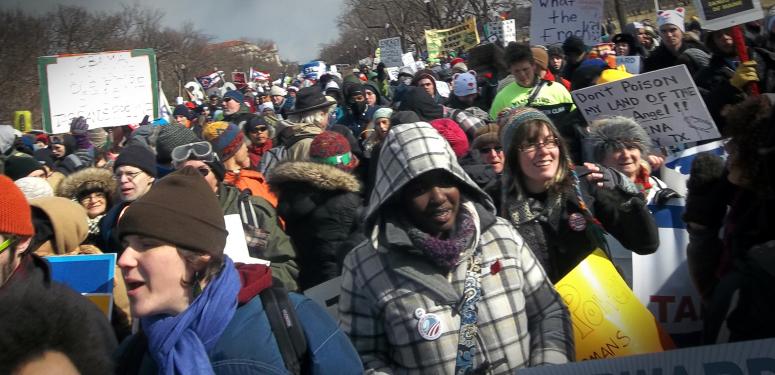
On Saturday, people of all ages, faiths, and occupations formed a huge body of marchers that jammed Pennsylvania Avenue from the Washington Monument to the Capitol. The Palestinian contingent of the mobilization comprised the largest ever Pro-Palestinian march in the United States, with an estimated 50,000 participants. There were well over 20,000 marchers from the other groups, which included the April 20 Mobilization (United We March) and International ANSWER. The Mobilization for Global Justice demonstrated against the IMF-World Bank structural adjustment policies, poor-country debt, and globalization. The Rain Forest Action Network mounted a huge green and blue earth at that protest to remind people of the ecological destruction involved in the War on Terrorism in Colombia and by large private U.S. banks.

On Sunday, The Colombian Mobilization carried on despite a cold rain and protested Plan Colombia, paramilitary human rights abuses, and the U.S. funding for paramilitaries.

The weekend protest continued into Monday at the Washington Hilton, scene of the meeting between Israeli Prime Minister Ariel Sharon and APAC, the American-Israeli Political Action Committee, with traffic-snarling "die-ins."

The coalition included four different groups with different reasons for protesting the War on Terrorism. Demands ranged from The April 20 Mobilization call for, among other things, a U.S. foreign policy based upon social and economic justice, not military and corporate oppression and an end to racial profiling and military recruitment targeting youth of color and working class youth, to Palestinian demands including ending U.S. military support for Israel, self-determination for Palestinians, and the freeing of Palestine from Israeli occupation.

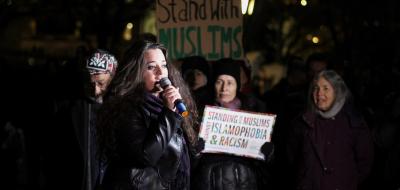
Whole families attended, lending the rally and march, a very friendly, gentle feeling. Nonetheless, Palestinian families brought important messages that they wished to convey. For instance, many carried posters displaying photographs of Palestinian infants shot in the chest or of children crying in the rubble of the devastation in the occupied areas-images that rarely get aired on U.S. television. Speakers from the New York Hospital Workers' Union joined in solidarity by affirming the need for jobs and schools for Palestinians instead of U.S. military funding used against Palestinians in their own land. Speakers from Vieques, Nicaragua, and Chiappas joined in the rejection of military occupation of peoples' homelands. The cry, "We are all Palestinians!" was often heard. Perhaps most notably, there were representatives of Muslim, Jewish, and Christian faiths among the speakers. A group of orthodox rabbis from New York offered a statement against Zionism as being contrary to the Torah's injunctions against suppression of other peoples. Speakers called for peace, but peace with justice for Palestinians and Israelis.

All of these coalitions were connected in one way of another with the War on Terrorism and had coincidentally planned events for the same weekend. Perhaps the earliest efforts to begin mobilizing, however, took place shortly after September 11. Following those terrible events, it did not take long for various student groups to begin resisting the idea of fighting terror with violence and the curtailments of civil liberties.

According to Eleiza Braun, of the National Youth and Student Peace Coalition, after 9-11 many campus organizations conferred together to draft a response to the Patriot Act, which critics say codifies restrictions of civil liberties under the guise of patriotism. Groups such as Students United Against Sweatshops, the Muslim Student Association, the Black Radical Youth Congress, and many civil rights and anti-death penalty groups sat down to plan a non-violent approach to the events of 9-11.

According Braun, "It was very exciting to put aside our own agendas and work face to face. We began combining with non-student groups such as the 9-11 Emergency Group, Pax Christi, and many others. Later, we began calling for a demonstration in April, but it wasn't going to be a one-time event. It would be a kick-off for a long-term effort at accountability regarding the war on terrorism. We students immediately grasped the effects of 9-11. Our response was based on the prospect that there would be less money to spend on failing schools, Social Security, and so many other public needs, that is to say, our future, not to mention the effects on civil liberties and the terrible suffering of innocents caught in the line of fire."

Braun expressed amazement at the oft-quoted 80% approval rating for President Bush and the war on terrorism. "On campuses, there was only 40% support. Students immediately realized that a war on 60 countries would affect them personally through military service, tuition hikes, or cuts in student aid. They even voted against the war at Hampshire College!" she said. "At the University of Missouri there was a March Against Hate involving more than 500 people. Before 9-11, we had 80 groups in the Student Peace Action Network. Now we have 300, and we get a call for a new chapter every week."

Braun worked with Maria Ramos, Roxanne Lawson, and Satya in coordinating the April 20 Mobilization. According to Lawson, "Past and present military spending accounts for 46% of the budget. Military spending only looks like 17% of the budget because Social Security revenues are included." Diverting money spent on unneeded fighter planes into school repairs, computer labs, low-income housing, health care for all, and countless other public needs would improve the lives of students and residents of Washington, DC, she said.

Like the Palestinian protest, the April 20 Mobilization had a range of notable speakers including Amber Amundson, Julia Beatty, Medea Benjamin, Phil Berrigan, Florio Cumpiano, Ron Daniels, Division X, Altaf Hussein, Kathy Kelly (nominated for a Nobel Peace Prize for her work with Voices in the Wilderness), Martin Luther King III, Hussein Ibish, Michael Ratner, David Rovic, Rev. Al Sharpton, Erica Smiley, and Brenda Stokely. International Answer and the Colombia Mobilization had equally impressive lists of speakers. Musical groups were also featured.